
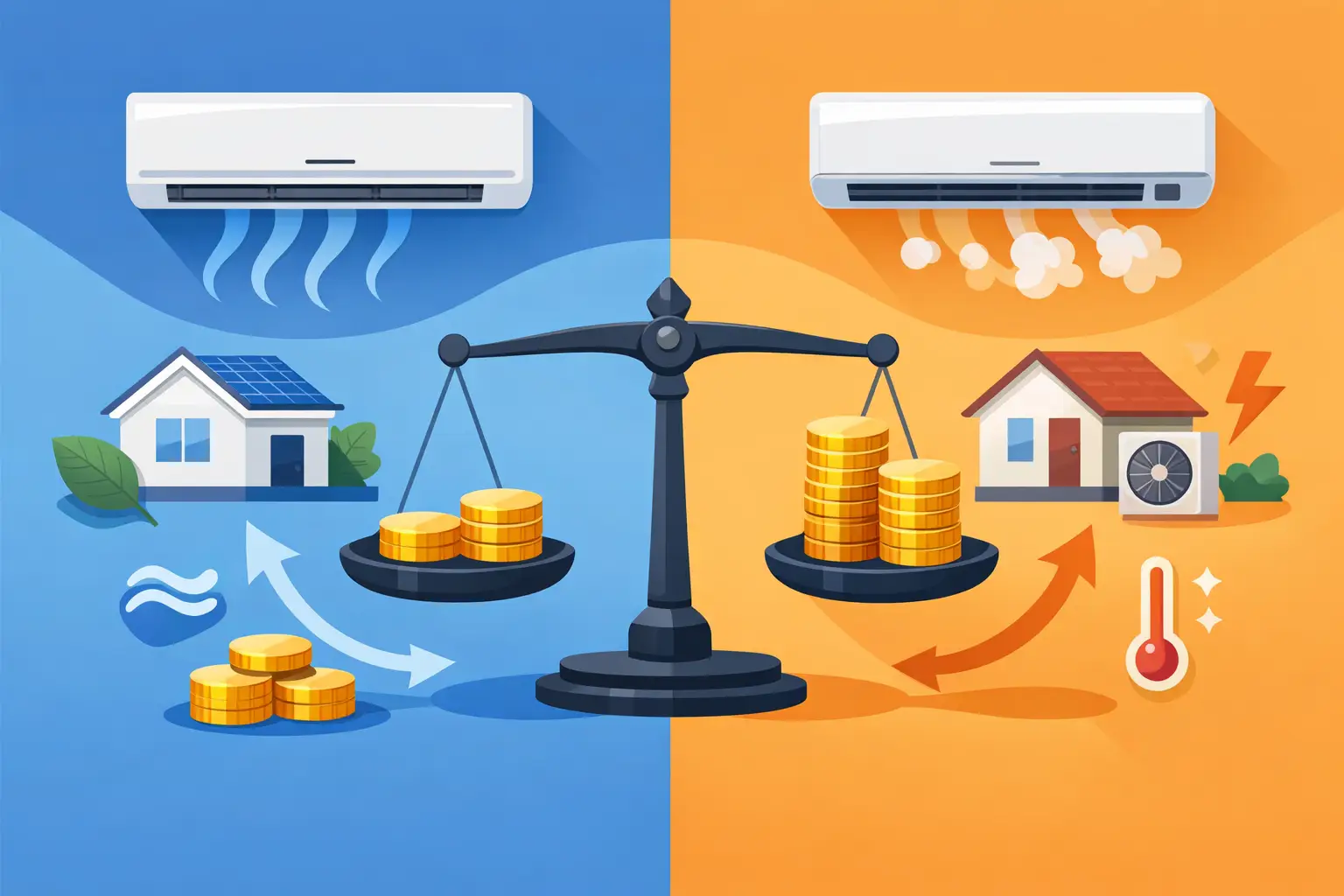
A new AC can look like a simple purchase until you compare inverter ac vs non inverter models. One may cost less at checkout, while the other can reduce electricity use and keep rooms more consistently comfortable over years of operation. The better choice depends on how often you run your AC, the size and condition of your space, and whether the system is selected and installed correctly.
For homeowners, tenants, and small businesses, the goal is not to buy the most expensive unit. It is to choose an air conditioner with the right capacity, operating cost, and service requirements for the room or property.
Inverter AC vs Non Inverter: The Main Difference
The difference is in how the compressor operates. The compressor is the part of the AC that removes heat from indoor air and sends it outside.
A non-inverter AC has a fixed-speed compressor. When the room reaches the selected temperature, the compressor turns off. As the room warms up again, it turns back on at full power. This on-and-off cycle repeats throughout the day.
An inverter AC uses a variable-speed compressor. Instead of shutting down completely once the room is cool, it slows down and adjusts its output to maintain the temperature. It may work harder when you first switch it on, then run at a lower, steadier speed after the room reaches the setting.
That operating difference affects electricity consumption, temperature control, noise, upfront price, and long-term value.
Energy Use and Monthly Electricity Costs
Inverter models are usually more energy efficient when the AC runs for several hours a day. Constantly restarting a fixed-speed compressor requires a high burst of power. An inverter compressor avoids many of those restarts by reducing speed rather than switching fully off and back on.
The savings are most noticeable in hot climates, large households, offices, and rooms where cooling is needed every day. If an AC operates overnight or throughout long afternoons, an inverter unit often has a clear advantage on electricity bills over time.
A non-inverter unit can still be a sensible option for a guest room, storage area, or space used only occasionally. If the AC runs for a short period once in a while, the energy-saving benefit may take longer to offset the higher initial price of an inverter model.
Actual energy use will vary. A correctly sized non-inverter AC can perform better than an oversized or poorly installed inverter unit. Room size, insulation, sunlight, occupancy, thermostat settings, and maintenance all influence the final bill.
Do not judge efficiency by the unit price alone
A lower purchase price can be attractive, especially when replacing several units. However, compare the full cost of ownership: purchase price, installation materials, electricity use, maintenance, and expected years of service.
For a primary bedroom, living room, or frequently occupied office, paying more upfront for an inverter system can be a practical long-term decision. For limited-use spaces, a reliable non-inverter AC may offer better value.
Comfort and Temperature Control
Inverter ACs generally provide more stable cooling. Once the room reaches the desired temperature, the compressor reduces output and makes smaller adjustments. This helps avoid the familiar pattern of a room becoming very cold, then noticeably warm before the next cooling cycle starts.
More consistent operation can also improve comfort at night. A unit running at a low speed is often quieter than a fixed-speed unit repeatedly starting at full output. This makes inverter systems especially suitable for bedrooms, nurseries, study rooms, and spaces where people work or sleep for long periods.
Non-inverter ACs cool effectively, but they are less gradual in operation. Some users prefer their strong, immediate cooling response, particularly when entering a hot room. The trade-off is greater temperature fluctuation and potentially more audible compressor cycling.
Upfront Cost and Installation Considerations
Non-inverter ACs are typically less expensive to buy. Their simpler fixed-speed technology can make them a practical choice when the budget is tight and the cooling requirement is straightforward.
Inverter ACs usually have a higher initial cost because of their variable-speed components and control systems. The price gap differs by capacity, brand, efficiency rating, and features such as Wi-Fi control, air filtration, or heat-pump operation.
Installation quality matters for both types. Proper wall mounting, secure electrical connections, correctly sized copper piping, drainage setup, vacuuming, pressure testing, and refrigerant checks all affect performance. A poor installation can cause weak cooling, water leakage, high energy consumption, noise, or premature component failure.
Before selecting a unit, confirm the AC capacity needed for the room. Bigger is not automatically better. An oversized unit may cool the air too quickly without properly managing humidity and may cycle inefficiently. An undersized unit may run continuously and still struggle during peak heat.
A professional assessment should consider room dimensions, ceiling height, window exposure, insulation, number of occupants, appliances that create heat, and whether the space opens into other rooms.
Maintenance and Repair Needs
Both inverter and non-inverter systems need regular servicing. Clean filters, a clean indoor coil, clear drainage, correct refrigerant levels, and an unobstructed outdoor unit help the AC cool efficiently and reduce strain on the compressor.
Inverter systems contain more advanced electronics, including a control board that manages compressor speed. This can make some repairs more specialized and potentially more costly if a major electronic component fails. It does not mean inverter units are unreliable. It means diagnosis should be handled by trained technicians using the right testing methods.
Non-inverter models have simpler controls and are often easier to diagnose in basic fault situations. However, any AC can develop issues if filters are ignored, drainage lines clog, piping is not installed properly, or electrical supply problems are left unresolved.
For either system, schedule maintenance before the hottest part of the year. A service visit should include filter cleaning, coil inspection, drain-line checks, electrical inspection, cooling performance testing, and a review of any unusual noise or odor.
Which Type Is Right for Your Space?
Choose an inverter AC if you use cooling daily, want lower long-term electricity consumption, value quiet operation, or need stable temperatures in bedrooms and regularly occupied living areas. It is often the stronger option for a home where AC is a major part of everyday comfort.
Choose a non-inverter AC if upfront price is your main concern, the room is used infrequently, or you need a dependable cooling solution for a secondary space. It can also work well when the expected operating hours are low enough that energy savings would be limited.
Brand, capacity, warranty coverage, and installation support should carry as much weight as the inverter label. A quality unit from a trusted manufacturer, matched to the room and installed professionally, will serve you better than a poorly selected model with impressive specifications.
Roukin Al Yarmouk can help customers select suitable AC equipment and arrange professional installation, so the unit’s capacity, piping, drainage, and performance are addressed from the start.
A good AC decision begins with your real usage pattern. Think about how many hours the unit will run, where it will be installed, and what you expect from it over the next several years. Then choose the system that keeps your space comfortable without creating unnecessary running costs or service headaches.